Jan 21,1976- A historic moment for mankind and more importantly for aviation. This marked the beginning of supersonic air travel when man successfully breached the sound barrier and could fly faster than the speed of sound. A landmark achievement for aviation indeed.
Some amazing features of the Concorde:
BA Concorde with its distinctive droop-down nose design
1. The speed of sound is about 340 m/s. The Concorde could fly at 694 m/s which is almost more than twice the speed of sound, making it the fastest trans-atlantic flight ever.
2. Travelling times were reduced drastically. A normal flight between New York and London which would otherwise take 8 hours could now be completed in merely 3.5 hours. It has achieved a speed of 2,179 kmph which is almost equal to covering the distance between Delhi and Chennai in 1 hour.
3. Wondering what makes it possible to fly at such a massive speed? The max ceiling of the Concorde is 60,000ft which is more than twice the max height of the Mount Everest which stands at 28,000 feet. For perspective, a B747 has a max ceiling of 38,000 ft while an A380 can hit upto 43,000 ft.
4.The climb rate of the bird was just as impressive with the ability to climb 100m in just 4 seconds. Talk about Usain Bolt's record in a 100m dash.
5. The Concorde, which costed around 46 million dollars in the 1970s, costed about 350 million dollars (at the time of it decommissioning).
6. Ticket fare for a one way trip across the Atlantic was about 6,270 dollars (4,58,288.72 Indian Rupees) while for a round-the-way trip it costed close to 13,000 dollars (9,50,199.90 Indian Rupees)
7. Out of the 20 that were ever built, only 14 made it for commercial operations. The other 6 were prototypes that were scrapped later on.
British Airways and Air France were the only operators of the type, with each operating 7 aircrafts.
Getty Images
Various airlines had placed orders for the Concorde back in the 60s and 70s. While British Airways and Air France were leading the race, the lower spectrum saw Air India, Braniff, CAAC, Continental Airlines, JAL, Lufthansa, and Sabena .Operators had the choice of choosing between 2 and 6 orders.
Air India's order
Air India, along with its Belgian counterpart, Sabena, placed the smallest order for 2 aircrafts. The order was officially made on on July 15th, 1964 placing India at the 9 position out of 18 airlines to place an order(at the time).
Marketing and demonstration
The next few years would see the Concorde indulging in heavy marketing for the type, organising round-the-world sales trips. As a part of the trip, the Concorde also made its way to the Indian skies.
Concorde taking off from Mumbai airport in the 80s
The Concorde made its demonstration flight in India when it was flown to Santa Cruz Airport ( now Chhatrapati Shivaji Maharaj International Airport). The aircraft departed from Bahrain and landed in Mumbai taking only 80 minutes as opposed to the standard 3 hours taken by subsonic jets. The aircraft then flew over Kolhapur in low heights to check the effects of supersonic speed on structures on the ground.
A team of civil aviation experts from the DGCA were specifically dispatched and pre-positioned at Kolhapur to analyze sound measurements. The final analysis reported the shaking of a few weak houses in Kolhapur and some glass window panes were also reported to be shattered. Following which, the regulator placed strict restrictions on supersonic flights over land areas.
Unfortunately, the deal didn't go through
Although Concorde was highly optimistic that Air India would convert this into a firm order, officials who participated in the negotiations were skeptical. According to experts, Concorde was an engineering marvel indeed but would prove to be economically disastrous in the years to come. It was no surprise then, that the deal was rejected in a matter of only a few hours.
If the airline had bought the Concorde, it would have gone into the red several years agoA top official of Air India commented during the event.
Thereby Air India finally concluded to cancel the order for two options for Concorde in February 1975.Unfortunately, the supersonic bird didn't survive too long with British Airways and Air France finally retiring it from service in 2003.
Fun fact
The letter "E" in Concorde has always been a subject of contention between the British and France, considering this was a joint venture between them. As can be seen, with the letter "E", the word Concorde becomes a french word. The British didn't prefer it although finally they came around when the British Prime Minister at the time, Tony Benn, compromised and stated that the "E" represented- "England", "Excellence, "Europe".
Images: The World Economic Forum, Reddit
COVER: Financial Times
Read next

IndiGo on Sunday (August 29) said it has appointed Canadian budget airline Westjet's former CEO Gregg Saretsky as a special advisor and he will work closely with the executive leadership team to accelerate operational and commercial improvement opportunities at the airline.
Saretsky joined the board of InterGlobe Aviation, the parent of IndiGo, as a non-executive director in October 2020. In a regulatory filing, the airline said that Saretsky has been appointed as a special advisor with immediate effect.
IndiGo has appointed Canadian budget airline Westjet's former CEO Gregg Saretsky as a special advisor
"In this capacity, Gregg will work closely with Rono Dutta, the executive leadership team of IndiGo, and Rahul Bhatia to accelerate operational and commercial improvement opportunities at the airline," the filing said. Bhatia is a promoter of IndiGo.
In the past, industry veterans appointed as advisors or consultants have made it to the helm of the airline's management. IndiGo's current CEO Ronojoy Dutta, a former executive at United Airlines was appointed as a consultant in IndiGo before becoming its chief. Before Dutta, Greg Taylor, former managing director of United was an advisor and then a CEO appointee.
He was formerly associated with WestJet and Alaska airlines.
Saretsky served as the President and CEO of WestJet, Calgary, Alberta (Canada) from March 2010 to March 2018. Before WestJet, Saretsky was associated with Alaska Airlines. He has been an independent director on the board of travel technology company Sabre Corp since July 2020.
"Gregg's understanding of the low-cost carrier model will serve us well as we work together to drive the change that will propel IndiGo to the next level and recover from the damaging effects of the pandemic," the filing said. IndiGo board has ten members.
Read next
How soon will we see the MAX series back in the skies again?-A realistic picture
Prashant-prabhakar
31 Aug 2021

The recent order of revoking the ban on the B737 MAX series came as a welcome news for operators in the country. Although Spicejet is the only airline operating the MAX series in India currently, Jet-Airways (now defunct) had 5 aircrafts in its fleet.
The new order permits Indian operators to fly these models subject to compliance with the Mandatory Modification to DGCA/B737-8&9/01R1 and EASA Airworthiness Directive of February 17, 2021is what the DGCA order said
But, is it simply enough for the bird to take to the skies? Well, theres more to it than meets the eye and the process might not be as simple as it sounds.
Now that the initial clearance is given, there are a lot of procedures and protocols in place, that need to be adhered to before this series can realistically take to the skies.
A successful return to service for these aircraft will need certain actions to be completed in terms of aircraft modifications and pilot training. Since the affected aircraft have been in storage, two sets of maintenance activities need to be carried out-Captain PP Singh, formerly Senior Vice President, JetLite, a unit of Jet Airways, said
According to Mr. Singh, the following needs to be done before the aircraft can be deemed fit to fly again:
1.To begin with, all activation tasks required to return to service shall be completed.These tasks essentially reverse the steps taken earlier to preserve the aircraft during storage. Preservation of an aircraft entails mothballing and safeguarding it against environmental damage by using physical/chemical barriers.
2. Manoeuvring Characteristics Augmentation System, or MCAS, is a flight stabilising program developed by Boeing, installed in the MAX series and were notorious for the two fatal crashes of Lion Air and Ethiopian Airlines.Hence mandatory modifications would be required to be made to the hardware and software as stipulated by the manufacturer and the regulator.
Modifications include taking inputs from two angle-of-attack sensors as opposed to just one. Crew would now be able to manually disable MCAS if necessary which wasn't an option earlier.
Additionally, separate changes will be required on the wiring based on directives issued by the FAA, following certain issues flagged by the regulator.
All these improvisations will be monitored by the airworthiness directorate of DGCA who will finally approve the completion of maintenance actions upon satisfactory compliance of established standards.
Pilot training
With all the software upgrades made, another requirement would be pilot training. Now training programs typically include several simulator sessions and computer-based training modules to provide a real-time understanding of the modifications made and practise all possible failure scenarios and recovery procedures.
CAE, Greater Noida has become the first simulator training facility in India to obtain clearance for B737 MAX simulator training.
Interglobe Enterprises
When all of these are in place, combined with the maintenance and training activities, can the aircraft take to the skies again. This is of course, subject to satisfactory compliance to standards set by the DGCA.
The plane will only fly after the DGCA gives a green signal after inspecting the modificationsCaptain Singh
Spicejet had earlier revealed its intentions of commencing operations as early as late September. According to a former official of DGCA, this again would take time as Spicejet still would have to fly a prescribed number of test flights in consultation with DGCA and recommendations put forward by the FAA.
About 344 MAX planes have been flown by 35 operators around the globe ever since the grounding was first revoked in December 9,2020. And as of today, they have achieved appreciable performance with no untoward events. American Airlines, Ryanair, flydubai, Air Canada and United Airlines are among the global airlines that have commenced operations with the MAX aircraft.
COVER: FlightGobal
Read next
Amid the ongoing COVID-19 pandemic, the Director-General of Civil Aviation on Sunday extended the suspension on scheduled international commercial passenger flights till September 30, 2021, said a circular by the office of DGCA.
However, international scheduled flights may be allowed on selected routes by the competent authority on case to case basis.
In a release, the DGCA said that the order will not apply to international all-cargo operations and flights specifically approved by the regulator. It also added that international scheduled flights may be allowed on selected routes by the competent authority on case to case basis.
https://twitter.com/DGCAIndia/status/1431862315729645569
CIRCULAR TWEETED BY DGCA
"In a partial modification on a circular dated June 26, 2021, the competent authority has further extended the validity of the circular issued on the subject cited above regarding Scheduled International commercial passenger service to/from India till 2359 hrs IST of 30th September 2021," stated the DGCA circular. "This restriction shall not apply to international all-cargo operations and flights specifically approved by DGCA.
However, International Scheduled flights may be allowed on selected routes by the competent authority on case to case basis," further stated the circular.
Scheduled international passenger flights were suspended in India on March 23, 2020, due to the coronavirus pandemic. The aviation authority has extended the ban several times since then.
International flights are currently operational under air bubble pacts. India has an air bubble arrangement with several countries
International flights are currently operational under air bubble pacts. India has an air bubble arrangement with the US, UK, UAE among others. “Transport Bubbles” or “Air Travel Arrangements” are temporary arrangements between two countries aimed at restarting commercial passenger services when regular international flights are suspended as a result of the COVID-19 pandemic. They are reciprocal in nature, meaning airlines from both countries enjoy similar benefits.
Read next
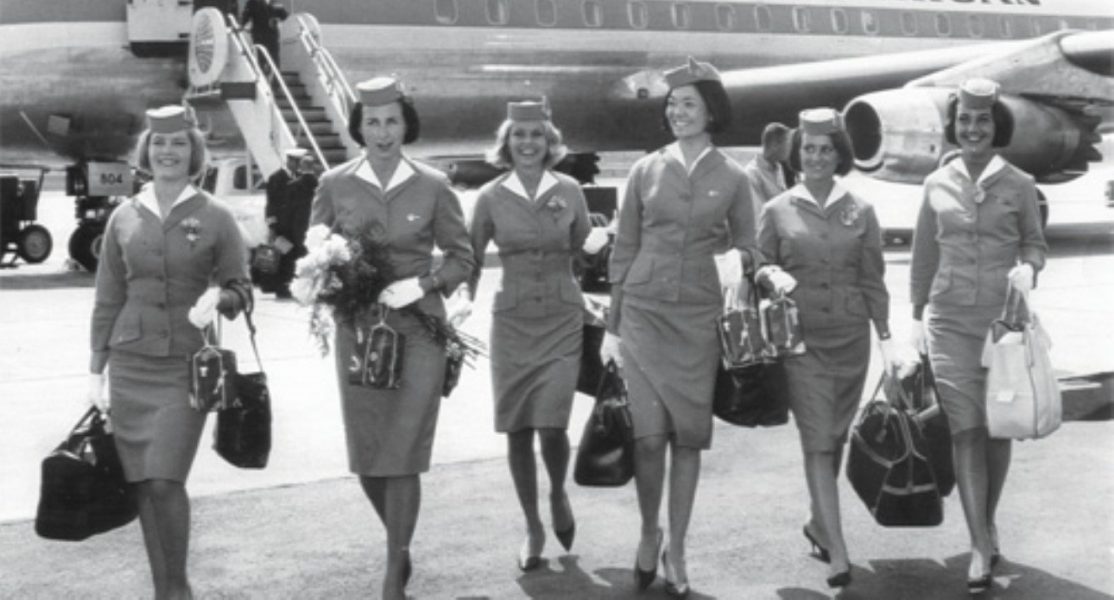
We've come a long way from the early rugged rough-ride airliners to the magnificent, engineering-marvels that we see today. The dress code of flight attendants have followed suit and numerous case studies have shown an intimate co-relation between the history of flight attendants and their dress code.In early days of flying, flight attendants were all registered medical practitioners, ever ready to handle all medical emergencies(and otherwise) on board. They were also subjected to stringent height and BMI parameters for job acceptance. Glasses were not permitted and there were restrictions on their personal relationships too.
Early dress codes drew inspiration from the attire of a nurse
The early '30s upto the '50s
The late 20s and early 30s saw military-style dress codes which were heavy and durable. With a main focus on projecting professionalism, caps and skirts which went beyond the knees was the norm.
An early SWISS AIR flight attendant. Traditional silhouettes were often clubbed with additional accessories like hats and panty hose.
Dress code in 1935 with a more military-style centric fabric and conservative silhouette
Classic suits with defined collars. Notice how the characteristic curled bobs and red lips also became a stand-out
With the passage of time, airlines started experimenting and by mid '40s up until the '50s ,cabin crew sported tailored blazers, midi-pencil skirts, and small heeled shoes. Hats replaced caps to exude the aura of a respectable and well-attired customer.
Hats and white gloves became more trendy during the 1950s. Scandinavian crew(inset)
Redefined strategy to boost airline profits
The airlines never stopped experimenting and this time around, they focused more on the assets of cabin crew employees. Unmarried women who met predefined height and weight parameters were highly sought after by airlines. By the late 1950s and almost throughout the entire 60s, it was common to see cabin crew in mini pants and knee-length boots. This was done to boost their appeal to male clientele, ensuring soaring profits for the airline. Belts of bright colours were also a part of the dress code.
The modern uniform as we see today
Post 1960, the sexist outfit design was done away with. Dress codes with a more professional look, akin to the dress codes of the 1930s came to the fore, of course with a modern twist.By the 1980s, the waistcoat and sleeveless jumper became part of the game. The mini skirts were cut out while the heels still remained. Knee-length skirts which exuded more professionalism were introduced. For men, pressed suit trousers with blazer as well as a white shirt is the general norm.
Dress code and local culture
Dress codes may not be thoroughly standardised as some airlines have their cabin crew don uniforms reflecting the traditional culture of their base country. India had its own unique way of promoting its traditional culture.
1.Air IndiaIt was way back in 1946 when Air India introduced the concept of Air Hostesses in India. The crew were mainly Anglo-Indian or British and sported tailored suits in a very unique European style.
By the 1970s, the exotic and mystical culture of India spread throughout the world and not surprisingly Air India cashed in on that. Air hostesses at this time were spotted donning Lehenga choli, Churidaar, and Silk Saree.Extravagant marketing, billboards and advertising promoting airlines as a brand were the next big thing.
Next time you fly 747 to New York, be unfaithfulan Air India ad in 1970
This was the beginning of a movement which focussed more on the visual appeal of marketing.
Saree not sorryThe 80s, 90s and early 2000 were entirely dedicated to colourful sarees.
Airlines now wanted to step it up a notch and portray themselves as flagbearers of modernity thereby adopting western blazer, shirt, and skirt. The Kingfisher airlines and Jet Airways (both now defunct) were the first to step into the race.
Kingfisher
Jet Airways
Fashion designer Rajesh Prataap Singh was hired to design Indigo cabin crew dress code. Vistara airlines collaborated with the fashion house Abraham & Thakore to develop their iconic Aubergine and gold dress.
IndiGo
Vistara airlines
Air hostesses walk the aisle like supermodels today, thanks to the partnerships the airlines have with various Stylists and Fashion designers.
Although airlines heavily regulate the overall code of uniforms, functionality over appeal is always preferred as unnecessary glamorizing doesn't add to any benefits.
COVER: SKYPRO news
IMAGES: All credits to respective owners
Read next
As beings with inquisitive minds, we are always curious about the trivial things. And as travellers and passengers, we always want to know where exactly our penny goes while booking tickets and expect airlines and travel agencies to share a fair break-up of the tickets we have paid for with our hard-earned money. Fairly enough, IATA came up with standardized steps to ensure customers are given a fair estimation of where exactly their money is going.
Rule 135(2) of the aircraft rules 1937,mandates that every airline providing commercial services present a fair break-up of the fare the customers pay for with a clear indication of the base charge and the other miscellaneous charges along with it. This is purely for passenger's convenience.
Let's, for instance, take the following as an example:
refundme.in
1.Base fare: The base fare is the basic fare the airlines charges excluding the convenience fees, fuel surcharges and other miscellaneous fees. Out of the entire fare break-up, the base fare and the fuel charges are what goes to the airline's pockets and the rest are directed towards the government and the airport operator.Now, let's say a discount is announced. It is usually based on the base fare and not the final fare(as is often mistakenly believed). For eg, there's a discount of 20% for DEL-BOM and the fare is INR10,000. Here, if the base fare is Rs.800,then the discount would be based on Rs.800 and not Rs.10,000,totalling the base to Rs.2000.
2.Fuel surcharge: Fuel surcharges contribute to about 40% to the entire operational costs of airline. These were introduced by airlines in India in around 2005-06 to offset for volatile fuel prices. Nowadays they are charged globally and are generally included in the original price of a ticket.
3.User Development Fee(UDF) : These are charges levied by the airport operator to recover the costs put into the development of the airport. These charges are variable with different rates for domestic and international arrival/departures as well.
Following are the Air India UDF rates charged with the corresponding airports:
Air India
In April 2014,Spicejet took off fuel surcharge as a separate feature and merged it with their actual base fare, making it the first airline in the country to do so.
There is an advantage in knowing the fuel surcharges separately though. In the event that a flight ticket is cancelled, DGCA rules stipulates that no amount more than the base fare+ fuel surcharges be levied on passengers. This kind of ensures you don't pay a hefty sum in cancellation charges.
4. The CUTE fee: This, if charged, refers to the services you use at the airport for check-in, mostly commonly referred to as Common User Terminal Equipment.
Impact of GST on airfares
Current taxation
TICKETSSERVICE TAX RATE(%)Economy5.6Business8.4
bemoneyaware.com
Under the new GST rules, the rates have been revised to:
TICKETSGST(%)Economy5Business12
bemoneyaware.com
The shift to GST seems to have positively affected the growth of the burgeoning civil aviation sector so far, as is evident .Although the business class fares would cost higher, it still is a marginal increase from 9-12% and obviously, frequent flyers would find it negligible.
Summary
Airlines derive major portion of their revenue from economy class passengers. They can claim ITC on input services from economy and for spare parts, food items and other inputs from business class. Thereby, it would be interesting to see if airlines are really willing to pass on the benefits of reduced tax rates to passengers or not.
COVER: CheapAir
Comment