
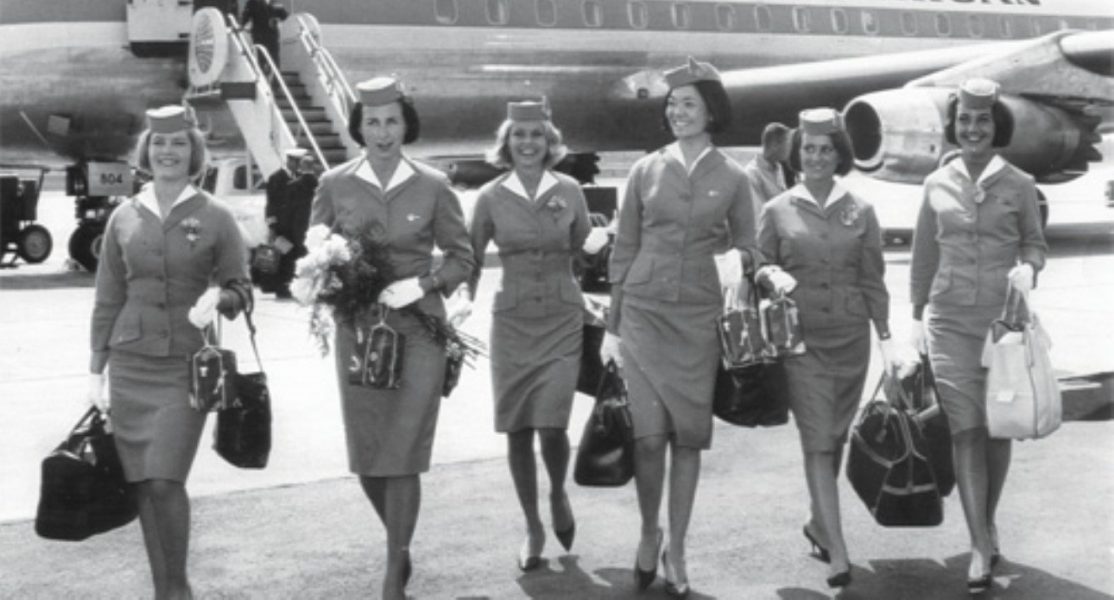
We've come a long way from the early rugged rough-ride airliners to the magnificent, engineering-marvels that we see today. The dress code of flight attendants have followed suit and numerous case studies have shown an intimate co-relation between the history of flight attendants and their dress code.In early days of flying, flight attendants were all registered medical practitioners, ever ready to handle all medical emergencies(and otherwise) on board. They were also subjected to stringent height and BMI parameters for job acceptance. Glasses were not permitted and there were restrictions on their personal relationships too.
Early dress codes drew inspiration from the attire of a nurse
The early '30s upto the '50s
The late 20s and early 30s saw military-style dress codes which were heavy and durable. With a main focus on projecting professionalism, caps and skirts which went beyond the knees was the norm.
An early SWISS AIR flight attendant. Traditional silhouettes were often clubbed with additional accessories like hats and panty hose.
Dress code in 1935 with a more military-style centric fabric and conservative silhouette
Classic suits with defined collars. Notice how the characteristic curled bobs and red lips also became a stand-out
With the passage of time, airlines started experimenting and by mid '40s up until the '50s ,cabin crew sported tailored blazers, midi-pencil skirts, and small heeled shoes. Hats replaced caps to exude the aura of a respectable and well-attired customer.
Hats and white gloves became more trendy during the 1950s. Scandinavian crew(inset)
Redefined strategy to boost airline profits
The airlines never stopped experimenting and this time around, they focused more on the assets of cabin crew employees. Unmarried women who met predefined height and weight parameters were highly sought after by airlines. By the late 1950s and almost throughout the entire 60s, it was common to see cabin crew in mini pants and knee-length boots. This was done to boost their appeal to male clientele, ensuring soaring profits for the airline. Belts of bright colours were also a part of the dress code.
The modern uniform as we see today
Post 1960, the sexist outfit design was done away with. Dress codes with a more professional look, akin to the dress codes of the 1930s came to the fore, of course with a modern twist.By the 1980s, the waistcoat and sleeveless jumper became part of the game. The mini skirts were cut out while the heels still remained. Knee-length skirts which exuded more professionalism were introduced. For men, pressed suit trousers with blazer as well as a white shirt is the general norm.
Dress code and local culture
Dress codes may not be thoroughly standardised as some airlines have their cabin crew don uniforms reflecting the traditional culture of their base country. India had its own unique way of promoting its traditional culture.
1.Air IndiaIt was way back in 1946 when Air India introduced the concept of Air Hostesses in India. The crew were mainly Anglo-Indian or British and sported tailored suits in a very unique European style.
By the 1970s, the exotic and mystical culture of India spread throughout the world and not surprisingly Air India cashed in on that. Air hostesses at this time were spotted donning Lehenga choli, Churidaar, and Silk Saree.Extravagant marketing, billboards and advertising promoting airlines as a brand were the next big thing.
Next time you fly 747 to New York, be unfaithfulan Air India ad in 1970
This was the beginning of a movement which focussed more on the visual appeal of marketing.
Saree not sorryThe 80s, 90s and early 2000 were entirely dedicated to colourful sarees.
Airlines now wanted to step it up a notch and portray themselves as flagbearers of modernity thereby adopting western blazer, shirt, and skirt. The Kingfisher airlines and Jet Airways (both now defunct) were the first to step into the race.
Kingfisher
Jet Airways
Fashion designer Rajesh Prataap Singh was hired to design Indigo cabin crew dress code. Vistara airlines collaborated with the fashion house Abraham & Thakore to develop their iconic Aubergine and gold dress.
IndiGo
Vistara airlines
Air hostesses walk the aisle like supermodels today, thanks to the partnerships the airlines have with various Stylists and Fashion designers.
Although airlines heavily regulate the overall code of uniforms, functionality over appeal is always preferred as unnecessary glamorizing doesn't add to any benefits.
COVER: SKYPRO news
IMAGES: All credits to respective owners

Read next

As beings with inquisitive minds, we are always curious about the trivial things. And as travellers and passengers, we always want to know where exactly our penny goes while booking tickets and expect airlines and travel agencies to share a fair break-up of the tickets we have paid for with our hard-earned money. Fairly enough, IATA came up with standardized steps to ensure customers are given a fair estimation of where exactly their money is going.
Rule 135(2) of the aircraft rules 1937,mandates that every airline providing commercial services present a fair break-up of the fare the customers pay for with a clear indication of the base charge and the other miscellaneous charges along with it. This is purely for passenger's convenience.
Let's, for instance, take the following as an example:
refundme.in
1.Base fare: The base fare is the basic fare the airlines charges excluding the convenience fees, fuel surcharges and other miscellaneous fees. Out of the entire fare break-up, the base fare and the fuel charges are what goes to the airline's pockets and the rest are directed towards the government and the airport operator.Now, let's say a discount is announced. It is usually based on the base fare and not the final fare(as is often mistakenly believed). For eg, there's a discount of 20% for DEL-BOM and the fare is INR10,000. Here, if the base fare is Rs.800,then the discount would be based on Rs.800 and not Rs.10,000,totalling the base to Rs.2000.
2.Fuel surcharge: Fuel surcharges contribute to about 40% to the entire operational costs of airline. These were introduced by airlines in India in around 2005-06 to offset for volatile fuel prices. Nowadays they are charged globally and are generally included in the original price of a ticket.
3.User Development Fee(UDF) : These are charges levied by the airport operator to recover the costs put into the development of the airport. These charges are variable with different rates for domestic and international arrival/departures as well.
Following are the Air India UDF rates charged with the corresponding airports:
Air India
In April 2014,Spicejet took off fuel surcharge as a separate feature and merged it with their actual base fare, making it the first airline in the country to do so.
There is an advantage in knowing the fuel surcharges separately though. In the event that a flight ticket is cancelled, DGCA rules stipulates that no amount more than the base fare+ fuel surcharges be levied on passengers. This kind of ensures you don't pay a hefty sum in cancellation charges.
4. The CUTE fee: This, if charged, refers to the services you use at the airport for check-in, mostly commonly referred to as Common User Terminal Equipment.
Impact of GST on airfares
Current taxation
TICKETSSERVICE TAX RATE(%)Economy5.6Business8.4
bemoneyaware.com
Under the new GST rules, the rates have been revised to:
TICKETSGST(%)Economy5Business12
bemoneyaware.com
The shift to GST seems to have positively affected the growth of the burgeoning civil aviation sector so far, as is evident .Although the business class fares would cost higher, it still is a marginal increase from 9-12% and obviously, frequent flyers would find it negligible.
Summary
Airlines derive major portion of their revenue from economy class passengers. They can claim ITC on input services from economy and for spare parts, food items and other inputs from business class. Thereby, it would be interesting to see if airlines are really willing to pass on the benefits of reduced tax rates to passengers or not.
COVER: CheapAir
Read next
A Dhaka-bound passenger flight made an emergency landing at the Nagpur airport as the pilot suffered a serious heart attack mid-air, an official said. The flight Biman Air BG-022 was en route to Dhaka from Muscat, news agency ANI reported.
A flight of the official carrier of Bangladesh, Biman, made an emergency landing at Nagpur International airport after its pilot suffered a massive heart attack. The flight was carrying 126 passengers from Muscat, the port capital of Oman, when the pilot, Captain Naushad, took ill.
A flight of the official carrier of Bangladesh, Biman, made an emergency landing at Nagpur International airport after its pilot suffered a massive heart attack.
On Friday, August 27, morning, the Nagpur Air Traffic Controller (ATC) received a call from the Biman air cockpit that a pilot had suffered a severe heart attack. And, he would need immediate help to land.
Following this, ATC Nagpur advised the airport management and alerted the terminal building about an unscheduled Biman Air landing as the pilot had a heart attack mid-air. “A medical team along with an ambulance was rushed to the spot for the pilot soon after the plane landed," a senior official told ANI.
"As per the latest information, the pilot is in stable condition now and the aircraft is currently parked in the Bay Area. All passengers have been deboarded and immigration is continuing. The airline is arranging crew sets for flight operations from Nagpur. The plane was passing near Raipur, Chhattisgarh. Immediately thereafter the aircraft established contact with Kolkata ATC and it coordinated with nearby ATC and directed the flight to land at Nagpur airport. The flight has landed in Nagpur safely."ATC official to ANI
Biman Bangladesh Airlines recently resumed flight services with India. Air travel between the two countries has been allowed by the governments following a long suspension because of the coronavirus pandemic.
Read next
With the Indian aviation watchdog, DGCA, giving clearance for the B737 MAX to fly again in Indian airspace, it opens up a lot of opportunities for key Indian players to step up their game in the industry. Akasa- a-yet-to-be launched ULCC by billionaire investor, Rakesh Jhunjhunwala, had earlier reported it would acquire about 70-100 B737 MAX planes in a span of 4-5 years. The approval from the DGCA couldn't have come at a better time for Akasa, who will now look to make the most of the situation and try to establish itself as one of the strong competitors in low cost flying in India.
India.com
Spicejet, who happens to be the only operator flying the 737 MAX currently in India, is also reported to have struck a deal with Avolon- a major 737 MAX lessor- to kickstart MAX operations in India, possibly by end of September. subject to regulatory approvals.
This is what Mr. Ajay Singh, the airline's chairman and managing director had to say about the deal:
I am delighted to share that our 737 Max will be back in the air soon. As India emerges from Covid and air traffic picks up again, the Max aircraft will play a major role in our future expansion. With a better and a more efficient fleet back in operation we expect a significant reduction in our operating costs improving our bottom line
Business Today
India had barred the MAX series from flying to, flying out of and overflying Indian Airspace- which was way back in March of 2019.
Two years later, in early April of 2021,DGCA relaxed the restrictions and allowed the flying back of foreign-registered MAX aircrafts in the country to their home bases. Additionally, it also allowed the overflying of certain modified MAX series over Indian airspace.
The DGCA had been closely monitoring the trend of global un-grounding of the MAX fleet although it wasn't quick to implement the same here in the country until the performance of the MAX was found to be satisfactory and complied with all flight safety regulations.
After numerous flight testings and safety procedures, DGCA chief , Arun Kumar issued an order revoking the March 2019 grounding of B737-8/9 Max. The order released is as follows:
This rescission enables operation of Boeing Company Model 737-8 and Boeing Company Model 737-9 (Max) airplanes only upon satisfaction of applicable requirements for return to service-said Kumar
The order further read:
Based on design changes by Boeing, (America’s) Federal Aviation Administration (FAA) issued an Airworthiness Directive (AD) on November 18, 2020, mandating actions for 737 Max airplanes return to service (RTS). Concurrent with the issuance of the AD, FAA rescinded the Emergency Order of Prohibition. Subsequently, European Aviation Safety Agency (EASA) also issued its own AD on February 17, 2021 which has been mandated by DGCA for compliance on Indian registered fleet
At the time of grounding, India had 18 MAX aircrafts in its inventory- 5 of the-now-defunct "Jet Airways" and 13 of Spicejet airline.
As of date, 175 countries out of 195 have authorised the operation of the MAX series and over 30 operators have returned the bird to service.
The DGCA’s decision is an important milestone toward safely returning the 737 MAX to service in India. Boeing continues to work with regulators and our customers to return the airplane to service worldwide- said Boeing, following DGCA's recent order on the B737 MAX series.
COVER: Arabian Business
Read next
Aviation Minister in talks with different states for the development of regional aviation sector

Radhika Bansal
13 Oct 2021

Jyotiraditya M. Scindia, the Union Civil Aviation Minister, has written to the Chief Ministers of several states requesting their intervention to instruct the concerned officers to take action to expedite various matters such as land allocation and fund deposition with Regional Air Connectivity Fund Trust (RACFT), VGF support for International UDAN operations, and other initiatives to improve aviation infrastructure in individual states.
To meet the country's growing passenger demand, AAI has invested INR 20,000 crore in the development and expansion of airports over the next 4-5 years.
Andhra Pradesh
In the letter written to the CM Y. S. Jagan Mohan Reddy, Mr Scindia has mentioned that the State Government has already handed over the quantum of land in most of the airports.
ANDHRA PRADESH AIRPORT
However, some portion of lands viz 14.31 acre at Tirupati required for extension of the runway and other operational requirements, 10.25 acre at Rajahmundry for construction of residential colony and 50 acres at Kadapa for extension of the runway and Approach Lighting System are yet to be handed over to AAI by the State Government. The diversion of the Eluru canal needs to be undertaken by the State Government for extension of the runway up to 4000 m at Vijaywada airport along with the approach lighting system.An amount of INR 14.64 Crore needs to be deposited with Regional Air Connectivity Fund Trust (RACFT) at the earliest by the Andhra Pradesh Government (20% of VGF share for UDAN flights till 31.07.2021 in the State). The Minister stated, “State Govt may give their consent to provide 100% VGF support for International UDAN operations (Vishakhapatnam - Dubai). On receipt of the consent of the State Government for 100% VGF support, routes will be put to bidding for the airlines.”
Arunachal Pradesh
Mr Scindia has written to the CM Pema Khandu seeking his intervention in land acquisition for various aviation sector projects which includes land requirements of 5.5 acres for installation of Non-Directional Beacon (NDB) and Doppler Very High-Frequency Omni Range (DVOR) protection area and construction of Residential Colony for airport staff at Tezu Airport.
TEZU AIRPORT, ARUNACHAL PRADESH
Another 70 acres at Dirang, 34.3 acres at Daporijo, 2.3 acres at Passighat, 7 acres at Along and 10.6 acres at Ziro. He said that the State Government needs to immediately operationalize heliports at Daparizo, Itanagar, Tuting, Walong, Yinghiong and Ziro, for which a Budget of INR 8.44 crores per heliport has already been allocated by this Ministry under Regional Connectivity Scheme (RCS)- UDAN (Ude Desh ka Aam Nagrik).
Assam
He has written to CM Himanta Biswa Sarma drawing his attention to the matter of land requirements of 78.5 acres at Dibrugarh Airport, 109 acres at Lilabari Airport, 1165 acres at Silchar Airport & 50 acres at Jorhat Airport. He mentioned that the land required at Dibrugarh Airport will be utilized for future expansion of the Airport and necessary runway strip, while that at Lilabari Airport will be used for construction of Isolation bay, necessary runway strip and development of a new Aviation Manpower Training Institute.
GUWAHATI AIRPORT, ASSAM
The land requested at Silchar Airport will be used to develop city-side infrastructure and land at Jorhat Airport will be used for the development of a New Civil Enclave. Out of the total projected land, only 8.5 acres of land has been handed over at Dibrugarh Airport, and the rest of the land parcels are yet to be handed over by the State Government.
Bihar
Mr Scindia has written to the CM Nitish Kumar, underscoring the land requirements of 49.5 acres at Patna airport for runway extension, Parallel taxi track, Doppler Very High-Frequency Omni Range (DVOR) equipment, Isolation Bay and Glide Path, 50 acres at Purnia Airport for development of New Civil Enclave, 121 acres at Raxaul to develop the airport for ATR-72 type of Aircraft, 475 acres at Muzaffarpur airport to develop it for the operation of A-320 type of aircraft, 78 acres at Darbhanga for development of new civil enclave along with CAT I approach light system.
GAYA AIRPORT, BIHAR
He said that Bihar should also take into consideration the scope for international connectivity and consequently viability of operation of a wide-body aircraft. Ministry has requested the State Government to consider the provision of 100% VGF support for commencing International UDAN operations from Patna and Gaya (Gaya - Bangkok, Gaya - Kathmandu, Gaya - Yangon, Patna - Kathmandu & Patna - Dubai). On receipt of the consent of the State Govt for 100% VGF support, routes will be put for bidding for the airlines.
Chattisgarh
While writing to the CM Bhupesh Baghel, he highlighted the matters related to the land requirement of 569 acres at Raigarh for the development of the airport to make it suitable for operations of ATR72/Q400 type of aircraft in Phase-l and AB-320 type of Aircraft in Phase-II. Further, the Minister observed that restoration of airport land in favour of AAI by the State Govt. is also pending at the end of the State Govt.
RAIPUR AIRPORT, CHATTISGARH
In addition, the Minister mentioned that an amount of INR 60 Lakh needs to be deposited with Regional Air Connectivity Fund Trust (RACFT) at the earliest by the State Govt. as 20% of Viability Gap Funding (VGF) share for Ude Desh ka Aam Nagrik (UDAN) flights till 31.07.2021 in the State. He also urged the Chief Minister to intervene and expedite the development of Ambikapur airport for 3C operations under Regional Connectivity Scheme (RCS) - UDAN operations for which a budget of INR 90 Crore has been allocated.
Goa
Mr Scindia has drawn the attention of CM Dr Pramod Sawant on various issues that are impacting the implementation of various projects about the aviation sector in Goa. He mentioned that long back AAI had requested 20.48 acres of land for construction of city side car parking and other infrastructural work at Goa Airport.
GOA AIRPORT
The cost of acquisition was also paid by AAI to the State Government of Goa. However, notification for the acquisition was issued by the State Government in respect of 15.50 acres only, out of which 9.23 acres is yet to be handed over to AAI.
Gujrat
Mr Scindia has drawn the attention of CM Vijay Rupani on the following issues that are impacting the implementation of various projects about the aviation sector in Gujarat:
BHAVNAGAR AIRPORT, GUJRAT
490.36 acres of land is required at Bhavnagar airport for making it suitable for operation of AB-320 type of aircraft.17.38 acres of land is required at Jamnagar airport for development of city side infrastructure.322.85 acres of land is required at Kandla airport for making it suitable for operation of AB-320 type of aircraft.434.5 acres of land is required at Porbandar airport for revision of orientation of runway and making it suitable for operation of AB-320 type of aircraft.18.33 acres of land is required at Vadodara airport for basic strip requirements and parallel taxi track.96.93 acres of land is required at Surat airport for installation of CAT-I approach lighting system and extension of runway. The State Government has also been requested for allocation of 2100 acres of land at Surat airport for development of 2nd runway.The State Government has been requested to clear the dues of Seaplane operation for operations between Sabarmati River Front and Kevadia.An amount of INR 47 Lakhs is outstanding on the part of State Government as VGF share for Regional Air Connectivity Fund Trust (RACFT).
Himachal Pradesh
Mr Scindia has drawn the attention of CM Jai Ram Thakur on the following issues that are impacting the implementation of various projects about the aviation sector in Himachal Pradesh:
SHIMLA AIRPORT, HIMACHAL PRADESH
AAI has projected a land requirement of 13 acres at Shimla airport for strengthening of runway and construction of AAI Residential Colony. Further, the State Government has been requested to extend support for removal of obstacles and provide requisite land for making Shimla airport compatible for operation of ATR-72 type of aircraft.The State Govt. has been requested to complete the infrastructure works at Shimla, Mandi, Manali and Baddi for operationalization of these heliports at the earliest.An amount of INR 1.44 crores is outstanding on the part of State Government as VGF share for Regional Air Connectivity Fund Trust (RACFT).
Jharkhand
Mr Scindia has drawn the attention of CM Hemant Soren on the following issues that are impacting the implementation of various projects about the aviation sector in Jharkhand:
JHARKHAND AIRPORT
For upgradation and development of Ranchi Airport, AAI has projected a land requirement of 506.4 acres, which is yet to be handed over to AAI.Similarly, AAI requires 545 acres of land for development of Dhalbhumgarh airport to make it suitable for operations of A-320 type of aircraft.The State Government has to complete the approach road to Deoghar airport, which is otherwise almost ready to be operationalized.
Karnataka
Mr Scindia has drawn the attention to the CM Basavaraj Somappa Bommai on the following issues that are impacting the implementation of various projects about the aviation sector in Karnataka:
KALABURAGI AIRPORT, KARNATAKA
AAI has projected land requirement of 370 acres at Belagavi airport, out of which only 348.6 acres have been handed over.Similarly, AAI has requisitioned for allocation of 240 acres at Mysore Airport. However, the said land is yet to be handed over by the State Government.The Govt. of Karnataka may take necessary steps to operationalize Shivamoga and Vijayapura airports so that the bids received under RCS-UDAN 4.1 can be considered for award. Further, the State Govt. needs to communicate its consent for 100% VGF support for the routes to be awarded from these two airports as these are part of State Regional Connectivity Scheme (SCRS).An amount of INR 7.55 Crores is outstanding on part of the State Government as VGF share for Regional Air Connectivity Fund Trust (RACFT).
Kerala
Mr Scindia has drawn the attention of CM Pinarayi Vijayan on the following issues that are impacting the implementation of various projects about the aviation sector in Kerala:
COCHIN AIRPORT, KERALA
AAI has projected a land requirement of 152.5 acres which is yet to be handed over by the State Government. Out of this, 137 acres will be used for development of apron, construction of new terminal building and cargo complex and remaining 15.25 acres will be used for car parking.
An amount of INR 5.29 crore is outstanding on part of the State Government as VGF share against Regional Air Connectivity Fund Trust (RACFT).
Madhya Pradesh
Similarly, while writing to CM Shivraj Singh Chouhan, Mr Scindia, underscored the following issues that are impacting the implementation of various projects about the aviation sector in Madhya Pradesh:
INDORE AIRPORT, MADHYA PRADESH
20.67 acres of land outside the airport boundary is required at Bhopal airport for relocating Bharat Scouts and Guides;20 acres of land is required at Khajuraho airport for basic strip and operational requirements;110 acres at Gwalior airport for extension of Civil Enclave;An additional 2314.52 acre of land is required at Indore Airport for development of 2nd runway and associated infrastructure.An amount of INR 1.79 crore is outstanding on part of the State Government as VGF share for Regional Air Connectivity Fund Trust (RACFT).The State Government may give its consent to provide 100% VGF support for International UDAN operations on Indore – Dubai route. On receipt of the consent of State Govt. for 100% VGF support, routes will be put for bidding by the airlines.
Maharashtra
While writing to CM Uddhav Balasaheb Thackeray, Mr Scindia has highlighted the following issues that are impacting the implementation of various projects about the aviation sector in Maharashtra:
PUNE AIRPORT, MAHARASHTRA
AAI has projected land requirements of 234.21 acres at Akola airport for development of basic strip and additional infrastructure. Out of this only 149.95 acres has been handed over to AAI. Remaining 84.26 acres is yet to be handed over. 182 acres of land is required at Aurangabad airport for runway extension and Parallel Taxi track for making it suitable for operation of Code “E” type of aircraft. 47.60 acres of land is required at Gondia airport for diversion of village road and city side development. 64 acres of land is required at Kolhapur airport for runway extension and installation of approach lights for development of airport for operation of AB-320 type of aircraft.An amount of Rs. 95 crore has been allocated for development of Amravati and Ratnagiri airports. The airports need to be developed by the State Government for commencing RCS – UDAN operations.Removal of chimney at Solapur may be considered at the earliest, so as to connect Solapur airport under RCS – UDAN.An amount of INR 12.02 crore is outstanding on part of the State Government as VGF share for Regional Air Connectivity Fund Trust (RACFT).State Govt. may give their consent to provide 100% VGF support for International UDAN operations on Pune – Dubai, Pune – Bangkok, Pune– Male, Pune – Singapore, Pune – Kathmandu and Pune – Kuala Lumpur routes. On receipt of the consent of State Govt. for 100% VGF support, routes will be put for bidding by the airlines.
Meghalaya
Shri Scindia has requested the personal intervention of CM Shri Conrad K Sangma in the expeditious operationalization of Tura Airport. He mentioned that the Ministry of Civil Aviation has launched RCS – UDAN to enhance regional air connectivity from unserved and underserved airports in the country by making air travel affordable to the masses. Tura airport figures in the tentative list of unserved airports. Bids for Helicopter operations have been received for two RCS routes i.e., Shillong to Tura Vv and Guwahati to Tura Vv in a special round of bidding 4.1 and the same is likely to be finalised soon as per the provisions of the Scheme document.
SHILLONG AIRPORT, MEGHALAYA
He has drawn the attention of Shri Sangma to the following issues:
On request of Meghalaya Government to Airports Authority of India (AAI) for taking over the Tura Airport, AAI had forwarded a draft MOU to State Government in 2013.Subsequently, for expansion and development of airport for operationalization of ATR-72 type of aircraft, AAI submitted proposal for acquisition of 56.5 acres of land and a DPR with development cost of INR 183.63 Crores to State Government vide letter dated 12.06.2017. State Government vide letter dated 18.08.2020 informed that survey is complete and process of obstacle removal is being initiated. AAI vide letter dated 18.09.2020 requested for additional information regarding existing infrastructure, land, finance, traffic demand and action plan.As per Air Safety requirement, provision of Runway End Safety Area (RESA) of 240 m x 60m is recommended and VFR operation with Simple Approach Lighting (SAPL) is proposed in Phase-1 along with City side infrastructure, runway extension. So an additional land of 68.5 acres needs to be acquired. Thus, total land area Of 125 acres need to be acquired and handed over to AAI, free from all encumbrances and free of cost, for development of Phase-I the airport.Further, for IFR operations with ILS and CAT-1 Lighting System, additional land of 115 Acre may be reserved by State Government.
Nagaland
Mr Scindia has drawn the attention of CM Neiphiu Rio on following issues that are impacting the implementation of various projects about the aviation sector in Nagaland:
DIMAPUR AIRPORT, NAGALAND
In Phase-1, land area of 107 acres is required for extension of runway by 310m for operations of AB-320 type of aircraft.In Phase-2, land area of 230 acres is required for city side development, extension of runway by 600m and runway strip clearance for operations of AB-320 type of aircraft along with hangars, RESA (Runway End Safety Area) and Isolation Bay.An amount of INR 18 Lakh, till 31.07.2021, is outstanding on part of the State Government as VGF share for Regional Air Connectivity Fund Trust (RACFT).
Odisha
Mr Scindia has drawn the attention of CM Naveen Patnaik on the following issues that are impacting the implementation of various projects about the aviation sector in Odisha:
BHUBANESWAR AIRPORT, ODISHA
AAI has projected land requirements of 178 acres at Jharsuguda for Phase –II expansion of the Airport. The land is yet to be handed over.Jeypore and Utkela airports need to be developed at the earliest by the State Govt. for the operations of RCS – UDAN flights.An amount of INR 1.48 crores is outstanding on part of the State Government as VGF share for Regional Air Connectivity Fund Trust (RACFT).State Govt. may also give their consent to provide 100% VGF support for International UDAN operations on Bhubaneswar – Dubai, Bhubaneswar – Abu Dhabi, Bhubaneswar – Bangkok, Bhubaneswar – Kuala Lumpur, Bhubaneswar – Colombo, Bhubaneswar – Singapore and Bhubaneswar – Kathmandu routes. On receipt of the consent of State Govt. for 100% VGF support, routes will be put for bidding by the airlines.
Puducherry (UT)
Mr Scindia has drawn the attention of CM N Rangasamy, on the issue of handing over land to AAI for the development of the Puducherry airport.
PUDUCHERRY AIRPORT
He mentioned that AAl has projected a revised land requirement of 161.5 acres (104 acres in the state of Tamil Nadu + 57.5 acres in the Union Territory of Puducherry) for extension of the Runway at Puducherry airport to make it suitable for the operation of ATR-72/Q-400 type of aircraft and IFR operations. However, the land is yet to be handed over to AAI by the UT administration of Puducherry and the State Government of Tamil Nadu.
Rajasthan
While writing to CM Ashok Gehlot, Mr Scindia, underscored the following issues that are impacting the implementation of various projects about the aviation sector in the state:
JAIPUR AIRPORT, RAJASTHAN
145 acres of land is required at Udaipur airport to meet DGCA CAR requirements for upgradation of runway.58.88 acres of land is required at Bikaner airport for expansion of Civil Enclave.55.9 acres of land is required at Jodhpur airport for construction of Apron and Terminal Building, AAI residential colony and CISF quarters.51 acres of land is required for development of New Civil Enclave at Uttarlai airport.Kotaand and Uttarlai airports are to be upgraded by the State Government.An amount of INR 94 Lakh is outstanding on part of the State Government as VGF share for Regional Air Connectivity Fund Trust (RACFT).Consent for 100% Viability Gap Funding (VGF) for State Regional Connectivity Scheme (RCS) routes is awaited from the State Government.
Tamil Nadu
While writing to CM M.K. Stalin, Mr Scindia has highlighted the following issues that are impacting the implementation of various projects of the aviation sector in the state:
COIMBATORE AIRPORT, TAMIL NADU
93.04 acres of land is required at Chennai airport for simple approach lighting system and development of other infrastructure. However, only 5.04 acres has been handed over to AAI. Remaining 88 acres is yet to be handed over.683.11 acres of land is required at Trichy airport for runway extension,basic strip, apron, terminal building and associated infrastructure.However, only 40.93 acres has been handed over to AAI. Remaining 642.18 acres is yet to be handed over.615.92 acres of land is required at Madurai airport for runway extension, approach lighting system and other associated infrastructure. However, 528.88 acres has been handed over to AAI. Remaining 87.04 acres is yet to be handed over.627.89 acres of land is required at Coimbatore for runway extension, new terminal building, apron and associated infrastructure.697 acres of land is required for development of Tuticorin airport. Out of which 600.97 acres has been handed over to AAI. Remaining 96.03 acres is yet to be handed over.446 acres of land is required for upgradation of Salem airport.Out of a total requirement of 62.07 acres required for RCS operations at Vellore airport, 13.37 acres is yet to be handed over. Further, 441 acres of land is required for development of Vellore airport to make it suitable for operation of Code-C type of aircraft.104 acres land falling in the territory of Tamil Nadu is required for development of the Puducherry airport to make it suitable for operation of ATR-72 type of aircraft.State Government is yet to allocate land to Indian Air Force, which in turnwill provide working permission to AAI for establishment of a Civil Enclave at Thanjavur airport.State Govt. may also give their consent to provide 100% VGF support for International UDAN operations on Coimbatore - Colombo, Coimbatore Dubai, Coimbatore - Singapore, Coimbatore Kuala Lumpur. Madurai- Dubai, Madurai - Colombo and Madurai - Singapore routes. On receipt of the consent of State Govt. for 100% VGF support, routes will be put up for bidding by the airlines.An amount of INR1.92 crore is outstanding on part of the State Government as VGF share for Regional Air Connectivity Fund Trust (RACFT).
Tripura
While writing to, CM Biplab Kumar Deb, Mr Scindia underscored the following issues that are impacting the implementation of various projects of the aviation sector in the state:
AGARTALA AIRPORT, TRIPURA
48 acres of land is required at Agartala Airport for Runway extension and relocation of Doppler Very High Frequency Omni Range (DVOR).Further, 50.5 acres of land at Kamalpur Airport and 75 acres of land at Kailashahar Airport are required for development of these airports for civilian aircraft operations (ATR 72 type aircraft).
Telangana
While writing to CM Shri K. Chandrashekar Rao, Mr Scindia has drawn his attention towards the issue of extension of the period of Concession Agreement for Hyderabad International Airport Limited (HIAL). He mentioned that a Concession Agreement (CA) dated December 20, 2004, has been executed between the Ministry of Civil Aviation, Government of India and HIAL for the development, construction, operation and maintenance of Hyderabad International Airport. In terms of clause 13.7.1 of CA, M/S HIAL has requested for extension of its concession period for another 30 years beyond the initial 30 years, i.e beyond March 23, 2038, and till 23.03.2068. The State Government has been requested to re-examine the request of HIAL for extension of the period of the Concession Agreement and furnish its recommendations to the Ministry of Civil Aviation.
HYDERABAD AIRPORT, TELANGANA
Shri Scindia also underscored the issue of operationalization of Warangal Airport and its inclusion under the Regional Connectivity Scheme (RCS)-UDAN (Ude Desh ka Aam Nagrik). He mentioned that Warangal Airport is within 150 km aerial distance of HIAL and can be developed with a mutually agreeable solution, to be explored by the State Government of Telangana with HIAL and Airports Authority of India (AAI).
Uttar Pradesh
Mr Scindia has drawn the attention of CM Yogi Adityanath, on the following issues that are impacting the implementation of various projects about the aviation sector in the state:
AGRA AIRPORT, UTTAR PRADESH
660 acres of land is required for phase wise development of Ayodhya airport.60 acres of land is required at Gorakhpur airport for development of New Civil Enclave.57 acres of land is required at Agra airport for expansion of Civil enclave at Agra.Ayodhya, Jhansi, Muirpur (Korba), Aligarh, Azamgarh, Moradabad, Chitrakoot, Saharanpur, Ghazipur and Shravasti airports are required to be developed by the State Government for commencement of RCS- UDAN operations.An amount of INR 2 crore is outstanding on part of the State Government as VGF share for Regional Air Connectivity Fund Trust (RACFT).
Uttarakhand
Shri Scindia has drawn the attention of CM Pushkar Singh Dhami, on the following issues that are impacting the implementation of various projects of the aviation sector in the state:
DEHRADUN AIRPORT, UTTARAKHAND
243 acres of land is required at Dehradun for Runway extension, establishment of New Terminal Building and other allied infrastructure.For development of heliports at Almora, Haldwani, Haridwar, Joshimath, Ramnagar, Mussoorie, Nainital and Dharchula, an amount of INR 8.44 crores each has been allocated. These are required to be upgraded by the State Government. An amount of INR 0.36 crore is outstanding on part of the State Government as VGF share for Regional Air Connectivity Fund Trust (RACFT).
West Bengal
Mr Scindia has drawn the attention of CM Mamata Banerjee, on the following issues that are impacting the implementation of various projects about the aviation sector in the state:
KOLKATA AIRPORT, WEST BENGAL
AAI has projected land requirement of 104.65 acres for development of the Bagdogra airport.37.74 acres of land is required for development of the Hasimara aiport for commencement of RCS operations.38.2 acres of land is required for development of Kalaikunda airport for commencement of RCS operations.There is a need for removal of obstacles at Burnpur Airport for making it suitable for RCS- UDAN operations.State Govt. may give their consent to provide 100% VGF support for International UDAN operations on Bagdogra- Kathmandu and Bagdogra - Bangkok routes. On receipt of the consent of State Govt. for 100% VGF support, routes will be put up for bidding by the airlines.An amount of INR 2.97 crore is outstanding on part of the StateGovernment as VGF share for Regional Air Connectivity Fund Trust (RACFT).Consent for payment of 100% VGF for State RCS routes on Kolkata Cooch Behar-Kolkata and Guwahati-Cooch Behar-Guwahati routes is yet to be received.
Read next
To give impetus to air travel, Union Minister for Civil Aviation, Jyotiraditya Scindia has written a letter to 22 States/ UTs urging them to rationalize VAT on ATF across all airports in States within the range of 1% to 4%. He has asked them to take forward common intention to boost air travel and connectivity in State to accelerate its economic development.
The price of ATF is a major component of the operating cost of airlines with that, the tax on ATF contributes significantly to the ATF price. Addressing this issue would enable a force multiplier effect concerning air connectivity in states.
Citing examples of progressive states such as Kerala, Andhra Pradesh, Meghalaya, Nagaland, Sikkim and Telangana, the Minister wrote that they have brought down the VAT to 1% and even below. As a result, they have seen a substantial jump in the number of aircraft movements in their states.
The price of ATF is a major component of the operating cost of airlines with that, the tax on ATF contributes significantly to the ATF price
For example, the Government of Kerala has brought down VAT on ATF from 25% to 1%. Subsequently, the number of aircraft movements at Thiruvananthapuram airport increased from 21,516 flights to 23,566 flights in a span of 6 months ie an increase of 2050 aircraft movements post-reduction of VAT. Similarly, aircraft movements at Hyderabad saw a rise from 76,954 flights to 86,842 flights in a span of 6 months i.e. an increase of 9888 aircraft movements after the reduction of VAT on ATF from 16% to 1%. Many other states, such as Andhra Pradesh, Chattisgarh, Nagaland, Orissa, Punjab and Sikkim have followed suit.
The Minister brought to the attention of the states that air connectivity directly promotes tourism growth, output growth and employment generation, in addition to various indirect benefits to the economy. In fact, the aviation sector has a high output multiplier of 3.25 and an employment multiplier of 6.1.
Presently, there is a huge disparity between States, and even within States, in terms of VAT being levied on ATF. Given the challenges that have arisen due to COVID-19. Hence, the Minister emphasised the need to reduce the existing VAT/Sales Tax on ATF to 1%-4% at all airports with immediate effect. Besides, it is worth noting that the revenue collected by the State on account of VAT on ATF is an insignificant proportion of the overall State finances. In any case, this will be more than offset by the positive impact of the air connectivity to the State through the flow of economic activities.
The 22 states/UTs to which the Minister wrote include Arunachal Pradesh, Assam, Bihar, Goa, Gujarat, Haryana, Himachal Pradesh, Jharkhand, Karnataka, Maharashtra, Madhya Pradesh, Mizoram, Rajasthan, Tamil Nadu, Tripura, Uttarakhand, Uttar Pradesh, Jammu & Kashmir, National Capital Territory of Delhi, Ladakh, Andaman Nicobar, and Dadra and Nagar Haveli and Daman & Diu.
Comment