
Built in Pune, Powered Globally: How GE Aerospace Is Turning India Into an Engine Superpower

Abhishek Nayar
13 Oct 2026

From a $200 Million Base, the American Engine Giant Is Doubling Down on India with a Sweeping 2030 Blueprint
GE Aerospace has announced plans to nearly double its supply chain spending in India — from USD 200 million in 2025 to USD 400 million by 2030 — a move that signals not just commercial ambition but a deep, structural bet on India's aviation future.
The announcement came on Monday through a report titled Powering Progress: GE Aerospace's Economic Impact in India, prepared in partnership with consultancy EY India.
Four Decades and Counting
GE Aerospace has been present in India for over 40 years, operating across civil aviation and defence segments. The company runs a manufacturing facility in Pune and a technology centre in Bengaluru, both of which serve as cornerstones of its India strategy.
The Pune facility, which has received cumulative investments of around USD 255 million, manufactures aero engine components and functions as a key global sourcing base. The Bengaluru Technology Centre, established in 2000, has earned over 1,000 patents and developed cutting-edge tools like the Analytics-Based Maintenance platform (ABM.ai) and the Blade Inspection Tool (BIT) for GEnx, CFM LEAP, and GE9X engines.
A Supply Chain Rooted in India
GE Aerospace currently works with 17 global suppliers based in India — including Tata Group, Mahindra, HAL, and Godrej — alongside a network of over 2,000 local suppliers. The company is expanding this base both by adding new components and by increasing volumes of existing sourced parts.
GE Aerospace South Asia CEO Vikram Rai stated that the increased spending reflects the company's long-term commitment to India's rapidly growing aviation ecosystem.
Engines in the Sky, Orders on the Books
As of 2026, more than 1,400 commercial engines and over 200 defence engines from GE Aerospace are in active operation across Indian carriers. Simultaneously, 3,200-plus GE Aerospace and partner engines are on order by Indian airlines.
In July 2026, IndiGo signed an MoU with CFM International — an equal joint venture between GE Aerospace and Safran Aircraft Engines — for over 1,000 LEAP-1A engines to power 510 Airbus A320neo family aircraft. The deal also includes support for IndiGo's upcoming engine MRO facility.
A Market Too Large to Ignore
India recorded 340 million domestic passengers in FY26, and that figure is projected to reach 1.1 billion by 2040. With 1,700-plus new aircraft on order by Indian carriers over the coming decade — most expected to fly on GE Aerospace or partner engines — the strategic logic behind this investment is unmistakable.
GE Aerospace isn't just supplying India's skies. It's building the infrastructure that will power them for generations.
Read next
Half a Lifeline: Indian Carriers Receive Only a Portion of Promised Credit
Abhishek Nayar
06 Oct 2026

A War Far Away, Turbulence at Home
When conflict broke out in West Asia in April 2026, Indian airlines soon felt the impact. Airspace restrictions and flight diversions meant closed skies and longer routes, forcing cuts in several international operations. Rupee depreciation, rising operational costs and a sharp increase in aviation turbine fuel (ATF) prices added to the strain.
A Rescue Plan Takes Off
Cabinet Clears ECLGS 5.0
In May, the Union Cabinet approved ECLGS 5.0 to ease liquidity stress on airlines, MSMEs and other businesses hit by the conflict. The scheme revives the model of the original ECLGS, launched during the Covid-19 pandemic to provide government-guaranteed, collateral-free credit to MSMEs. It carries a total outlay of Rs 18,100 crore and aims to unlock additional credit of up to Rs 2.55 lakh crore, of which Rs 5,000 crore is earmarked for aviation.
What Airlines Get
For airlines, the government provides a 90 per cent credit guarantee through the National Credit Guarantee Trustee Company Limited (NCGTC), with no guarantee fee. Eligible scheduled passenger airlines can raise additional credit of up to 100 per cent of their peak credit outstanding during January to March 2026, capped at Rs 1,500 crore per borrower across the banking system. Loans carry a seven-year tenor, including a two-year moratorium on repayment, and the guarantee runs for the full tenor. Only standard accounts with outstanding credit facilities as on March 31, 2026 are eligible, and loans must be sanctioned by March 31, 2027.
Sanctioned, But Not Delivered
Banks Hesitate
Airlines that sought credit under the scheme have received only a portion of the sanctioned assistance. The release of the balance amounts has been delayed in several cases because of "continued hesitation" on the part of lending institutions.
The Industry Knocks on the Minister's Door
FIA Writes to Naidu
The Federation of Indian Airlines (FIA), which represents Air India, IndiGo and SpiceJet, has written to Civil Aviation Minister Ram Mohan Naidu seeking expeditious disbursement of credit support to eligible member airlines. The letter describes "unprecedented financial and operational challenges" and says recent developments have "severely strained airline liquidity and working capital," necessitating immediate government support.
A Plea for Reassurance
The industry body appreciates the government's initiative but notes that not all its members require credit under the scheme. It has asked the Ministry of Civil Aviation (MoCA) to offer appropriate guidance and reassurance to participating banks, beginning with the first tranche, so that balance sanctioned amounts are released. Timely disbursement, FIA said, would help airlines meet critical operational and working-capital requirements and keep connectivity running across the country.
Bigger Than Balance Sheets
The federation stressed that airlines play a critical role in national connectivity, trade, tourism, employment and economic growth, and that the sector's sustainability matters for Viksit Bharat 2047. Timely support, it said, is critical to protect the aviation ecosystem.
Read next
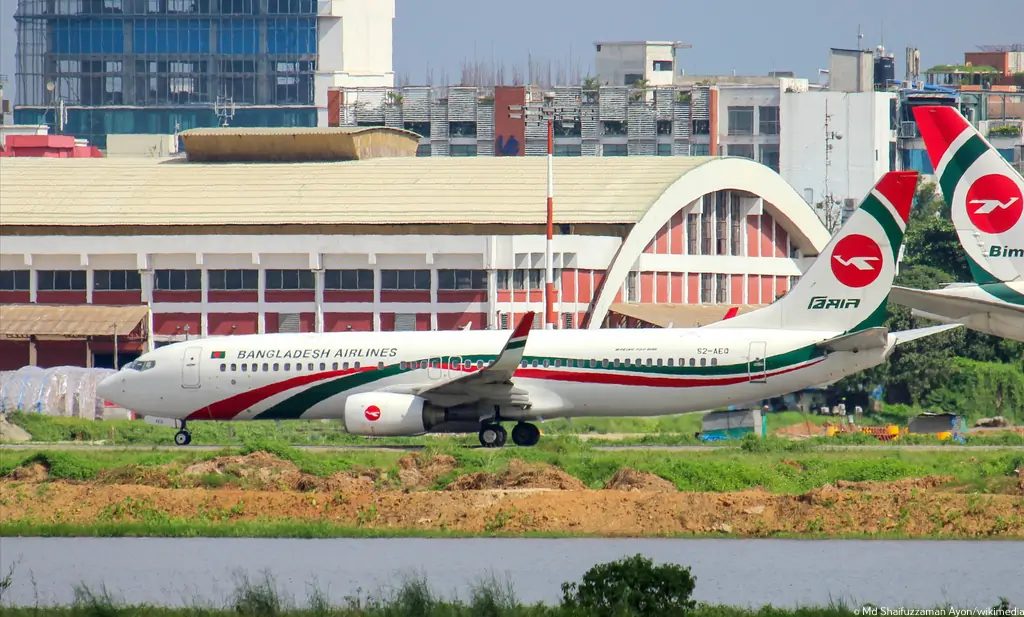
Biman Bangladesh Airlines, the country's national flag carrier, currently operates a fleet of 19 aircraft. The fleet consists mainly of Boeing jets and Dash-8 turboprops. Despite its modest size, the airline serves slightly more than 20 percent of the country's air passengers, according to Civil Aviation and Tourism Minister M. Rashiduzzaman Millat.
The Boeing Deal Comes First
Eleven More Jets Join the Order Book
Bangladesh's government recently signed a deal for 11 additional Boeing jets for its national carrier. The latest order covers five 787-10 Dreamliners and six 737-8 MAX aircraft. With this agreement, Biman's Boeing commitments now total 25 aircraft.
Airbus Enters the Picture
Ten More Aircraft on the List
Only days after the Boeing agreement, the government signalled that its fleet shopping is far from over. Bangladesh is now looking to buy 10 aircraft from France's Airbus for Biman, Millat said, as the administration pushes ahead with plans to expand the national carrier's fleet.
What Airbus Would Deliver
The proposed purchase includes four A350-900 wide-body aircraft and six A321neo narrow-body jets. If the deal goes through, the Airbus acquisition would add to Biman's Boeing commitments, giving the airline aircraft from both of the world's biggest planemakers.
Where the New Planes Would Fly
Long Haul and High Demand
The planned A350s would mainly operate high-demand routes to the Middle East, along with long-haul services to Europe and North America. These are the routes where a bigger, more modern wide-body presence could matter most for a carrier of Biman's size.
Closer to Home
The A321neos, by contrast, would be deployed on regional and shorter-haul routes. This would give the airline a dedicated workhorse for shorter journeys, alongside the long-range ambitions of the A350s.
What Happens Next
A Signing Could Come as Early as October
The government could sign an agreement with Airbus as early as October, Millat said. If that timeline holds, Biman would have moved from a 19-aircraft fleet of mainly Boeing jets and turboprops to a substantially larger order book within a matter of weeks. For a carrier that currently serves just over a fifth of the country's air travellers, the coming months could prove decisive.
With Inputs from Reuters
Read next
India's Youngest Major Airline Just Built a Loyalty Base of One Lakh in Thirty-Five Days
Abhishek Nayar
26 Sep 2026

Akasa Air announced that its newly launched loyalty programme, Akasa Elevate, surpassed the 1,00,000-member mark — all within five weeks of going live. The achievement positions Akasa Air among the fastest airlines in India to build a six-figure loyalty base, and signals something more significant than just impressive numbers: passengers are choosing to stay.
Born on an Anniversary
Akasa Elevate was launched to coincide with the airline's fourth anniversary, a deliberate choice that tied the programme's identity to the airline's growth story. Designed to reward frequent flyers with greater value, personalised recognition, and enhanced travel benefits, the programme builds directly on what Akasa calls the "Akasa Experience" — warm, dependable, and increasingly aspirational service.
How the Programme Works
Members earn Elevate Points on eligible flights and ancillary purchases, with bonus rewards on direct bookings. The programme operates across four tiers, with progression unlocked through either flights flown or money spent — making it accessible regardless of how a customer travels. Higher tiers bring unlimited priority services, premium airport recognition, dedicated support, and a range of benefits covering seats, baggage, meals, and travel flexibility.
For those who flew Akasa before the programme existed, the airline introduced a limited-period Retro Claim feature, allowing passengers who travelled from April 1, 2026 onwards to join Akasa Elevate and claim their points retrospectively — a move that immediately rewarded the airline's most loyal early adopters.
What Leadership Is Saying
Naarayan T V, Chief Marketing Officer at Akasa Air, credited the milestone to the trust passengers have placed in the brand. He noted that at the core of Akasa's growth is a rapidly expanding base of repeat customers whose preferences have directly shaped the airline's evolution, adding that the airline remains deeply grateful to every member who chose to be part of this journey.
The Bigger Picture
Akasa Elevate's rapid rise does not exist in isolation. The airline currently operates 43 Boeing 737 MAX aircraft across 37 destinations, spanning 31 domestic and seven international cities. It has served over 30 million passengers since launching in August 2022, and holds a firm order for 226 Boeing 737 MAX aircraft — a fleet that is both the youngest and greenest flying Indian skies today.
The programme, by design, is built to scale alongside this expansion, promising new capabilities, partnerships, and benefits as Akasa Air's network continues to grow.
Read next
Three Years Old and Already Ordering 200 Jets. What Is Akasa Air Building?
Abhishek Nayar
25 Sep 2026
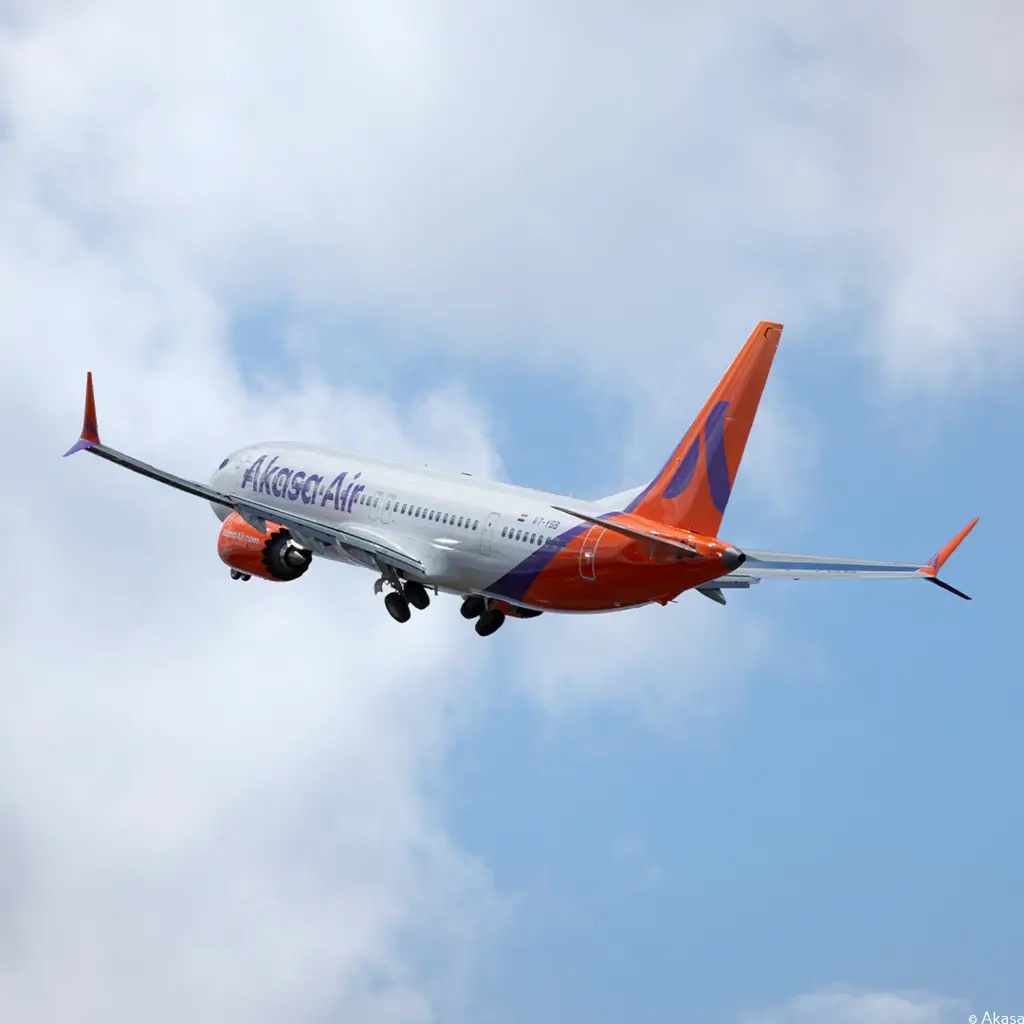
Akasa Air, India's third-largest airline, is in advanced talks to order more than 200 Boeing 737 MAX jets, citing people familiar with the matter. The Mumbai-based carrier, which only took to the skies in 2022, is rapidly positioning itself as one of Boeing's most ambitious customers in Asia.
The proposed order is designed to extend Akasa's fleet pipeline well into the next decade. The airline already holds unfilled orders for 183 Boeing 737 MAX aircraft — making this additional purchase a move to sustain growth momentum beyond 2032.
Where Things Stand Today
As of now, Akasa operates a fleet of 43 Boeing 737 MAX jets. Nine aircraft have been delivered so far in the current calendar year, adding to a fleet that has grown steadily since the carrier's launch. The 737 MAX remains central to Akasa's strategy, prized for its fuel efficiency and lower operating costs — a critical edge in India's fiercely competitive aviation market.
What Comes Next and When
A formal decision on the potential order is expected early next year, with final terms likely to be locked in during the second half of 2027. While negotiations are ongoing, the scale of the deal signals Akasa's confidence in India's long-term air travel boom and its own trajectory within it.
Going Global: The 60-40 Ambition
Beyond fleet size, the order is intertwined with a bolder strategic shift. Akasa is targeting a 60-40 domestic-to-international capacity split over the next two to three years — a significant departure from its current domestic-heavy operations.
Chief Executive Vinay Dube made the airline's international ambitions explicit in August. "I can see us getting up to 60-40… maybe two to three years from now," he said. "As aircraft deliveries improve, we will allocate more capacity to international destinations."
The numbers already tell a compelling story. DGCA data shows Akasa carried 400,525 international passengers in just the first half of 2026 — surpassing the 368,743 international passengers it flew across the entirety of 2025.
A Young Airline Playing the Long Game
What makes Akasa's trajectory remarkable is its speed. In roughly four years, the carrier has gone from launch to negotiating one of the largest aircraft orders in Indian aviation history. By securing deliveries deep into the 2030s, Akasa is not merely reacting to demand — it is building the infrastructure to shape it.
For Boeing, the deal would further cement a relationship that has already delivered one of its more consistent order books in the region. For India's aviation sector, it is yet another signal that the country's air travel market is no longer just growing — it is transforming.
Read next
Who Owns the Sky? India's Government Wrestles With a High-Stakes Aviation Question
Abhishek Nayar
23 Sep 2026

India's Civil Aviation Minister K Rammohan Naidu stirred considerable buzz in the aviation industry when he publicly acknowledged that the government is actively weighing the possibility of allowing airport operators to hold ownership stakes in airlines — a move that could fundamentally reshape how India's aviation ecosystem is structured.
Naidu made the remarks while speaking to reporters on the sidelines of a signing ceremony for the next phase of the Udaan regional connectivity scheme.
The Scale India Needs
Before addressing the ownership question, the minister laid out an ambitious baseline for India's aviation future. He stated that to fully capitalise on the country's current surge in air travel demand, India needs a minimum of five airlines each operating fleets of at least 100 aircraft — a scale the country is yet to reach.
He also reiterated the government's commitment to expanding airport infrastructure, saying India should ideally have over 350 airports. "People, even in small towns, want airports in their vicinity," Naidu said, framing the expansion as both a present aspiration and a long-term necessity tied to the Viksit Bharat 2047 vision.
The Adani Question That Sparked It All
The conversation took a sharper turn when a reporter raised the Adani Group's reported interest in acquiring a stake in an airline. The minister did not address the conglomerate by name, but his response was pointed: the country needs more airlines, and if someone is willing to invest in starting one, the government is supportive.
"The first idea is to provide the passenger with more airlines as an option," Naidu said.
A Legal Grey Zone — With Exceptions
Naidu also clarified an important legal nuance. While Operation, Management and Development Agreements — known as OMDA agreements — governing major PPP airports such as Delhi and Mumbai do contain restrictions on airport operators owning airlines, not all airport operators are bound by such clauses.
Pointing specifically to Delhi International Airport Limited (DIAL), a private operator, the minister noted there is currently no rule that explicitly prevents it from launching an airline. "That is why we have to see; we have to take a balanced approach," he said.
No Decision Yet — But the Deliberation Is Underway
Naidu was careful to note that no final decision has been made. The government, he said, will assess the pros and cons of the cross-ownership model before moving forward. The broader intent, however, appears clear: India's aviation policymakers are seriously entertaining a structural shift that could open the skies to a new class of airline investors — ones who already own the runways.
Comment