
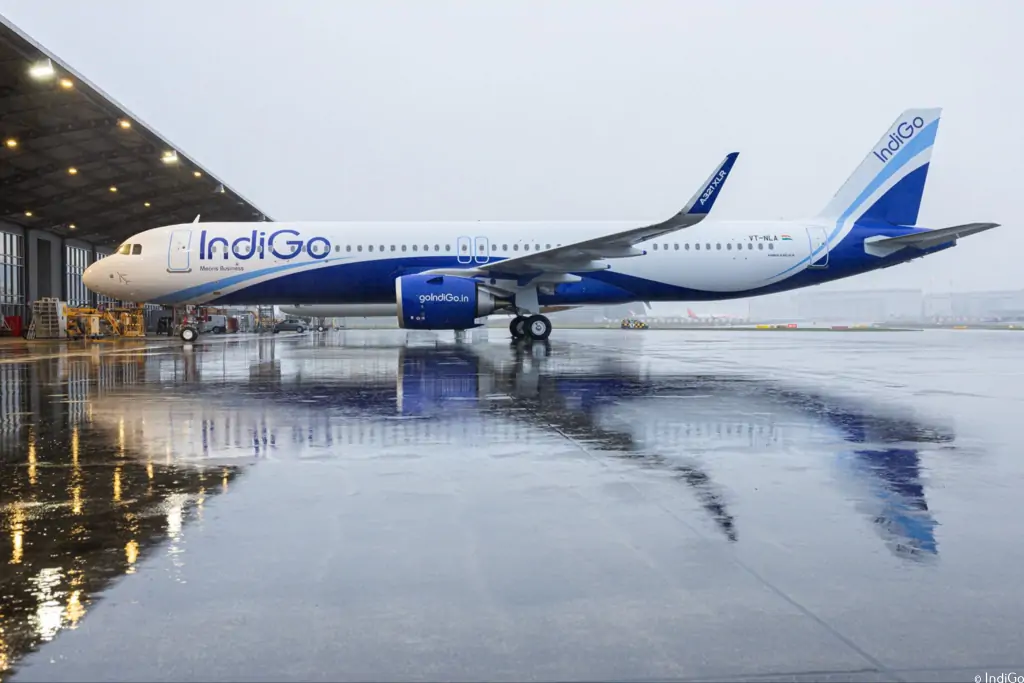
InterGlobe Aviation, the parent company of IndiGo, announced on Friday that its Board of Directors had approved a plan to deploy up to $450 million toward the acquisition of aircraft, engines, and other aviation assets. The decision was disclosed through a regulatory filing released alongside the airline's quarterly financial results, signaling an intent to shift meaningfully toward fleet ownership rather than reliance on leased equipment.
Under the approved structure, InterGlobe Aviation will partially prepay finance lease obligations worth up to $450 million to InterGlobe Aviation Financial Services IFSC Pvt Ltd, a wholly owned subsidiary. The subsidiary will then channel these funds into acquiring aviation assets, including aircraft, aircraft engines, and spare parts.
A Fleet Built for the Long Haul
The move comes as IndiGo continues to aggressively expand its network. During FY26, the airline grew its capacity by 9.5 per cent to 172.4 billion available seat kilometres (ASKs) and carried 123.4 million passengers across the full financial year. By the close of March 2026, IndiGo's fleet had grown to 441 aircraft, ranking it among the largest airline fleets in the region.
The carrier's fleet today is notably diverse, comprising Airbus A320 and A321 variants, ATR turboprops for regional routes, dedicated freighter aircraft, and both Boeing 737 and Boeing 787 planes for wider network coverage. During the January-March quarter, the airline added a net one passenger aircraft to its operating lineup.
A Difficult Quarter Clouds the Picture
The fleet expansion announcement arrived alongside a set of weak quarterly earnings. IndiGo reported a net loss of Rs 2,536 crore for the January-March quarter — a stark reversal from the profit of Rs 3,067 crore posted in the same period a year earlier. Revenue from operations remained largely stagnant, registering a marginal rise of about 1 per cent year-on-year to Rs 22,438 crore.
Operationally, the quarter presented multiple headwinds. While capacity rose 3.4 per cent despite disruptions tied to tensions in West Asia, passenger traffic slipped 1.1 per cent to 31.6 million travelers. Seat occupancy fell to 85.8 per cent from 87.5 per cent recorded in the same quarter a year ago.
Profitability also took a hit from weaker yields and elevated costs. Revenue earned per available seat kilometer dropped 2 per cent year-on-year, while non-fuel operating costs remained high. Although lower fuel prices provided partial relief, they were insufficient to counter the dual pressure of weaker revenue and adverse foreign exchange movements.
The Full-Year Picture Holds Steadier Ground
Despite the quarterly setback, IndiGo maintained that its core business remained fundamentally resilient. For the full financial year FY26, the airline posted a profit of Rs 7,500 crore when the impact of foreign exchange movements and exceptional items is excluded — a figure the airline cited as evidence that its underlying operations continue to hold firm as it pursues long-term fleet and network growth.

Read next
Two of India's most prominent carriers — Air India and IndiGo — have announced significant reductions in their flight operations for the June to August 2026 period, citing the sustained burden of elevated aviation turbine fuel (ATF) prices as the primary driver. The twin announcements mark one of the more consequential capacity pullbacks in Indian domestic aviation in recent memory, raising immediate questions about seat availability and airfare levels through the summer travel season.
Air India has confirmed a reduction of up to 22 per cent in its domestic flight schedule across the three-month window — the steeper of the two cuts. IndiGo, which holds the largest market share in Indian aviation, has announced a comparatively smaller but still significant 5 to 7 per cent reduction in domestic capacity, alongside a sharper 17 per cent cut in international capacity.
Air India's Official Statement: 'Temporarily Rationalized Operations'
Air India made its position official on Wednesday, confirming that it had temporarily rationalized operations on certain domestic routes, with reductions in frequency on select sectors between June and August 2026. The airline clarified that this domestic adjustment follows a prior decision to trim select international services during the same period — meaning the carrier has now curtailed both its international and domestic networks in parallel.
In a statement, Air India said the adjustments were driven by the sustained impact of high fuel prices on overall operations — language that points directly to the structural cost pressure ATF costs have placed on the airline's commercial viability over recent months.
The Root Cause: A Global Fuel Crisis Traced to the Middle East
The fuel crisis currently battering Indian aviation is not isolated — it is the downstream consequence of a sharply escalating geopolitical situation. Brent crude oil prices surged more than 50 per cent over roughly three months as tensions in the Middle East intensified following the conflict between the United States and Iran. Energy markets have remained under sustained pressure due to fears of prolonged supply disruptions across the region.
A critical pressure point has been the Strait of Hormuz — one of the world's most strategically important oil shipping routes — where disruptions have directly impacted global crude supply. The Strait handles a significant share of global crude oil transportation, and any interruption along the route sends immediate shockwaves through international energy markets.
Prices Ease Slightly, But the Damage Is Already Done
Although Brent crude prices have moderated from their peak and were trading at around USD 96 per barrel at the time of reporting, they remain significantly elevated compared to the levels that prevailed before geopolitical tensions escalated. For airlines, which lock in operational decisions weeks in advance, the damage from the sustained price spike had already been absorbed — and the reduced summer schedules are the visible result of that financial strain on India's civil aviation sector.
Read next
Can Compensation for Engine Failures Really Be Taxed as a "Service"? IndiGo Takes the Fight to Delhi High Court
Abhishek Nayar
25 May 2026
The Delhi High Court on Friday granted interim relief to InterGlobe Aviation, the parent company of IndiGo, restraining tax authorities from taking any coercive action against the carrier in connection with a Goods and Services Tax demand of nearly Rs 458 crore. A Division Bench of Justice Nitin Wasudeo Sambre and Justice Ajay Digpaul, at the preliminary stage itself, observed that the payments received by the airline appeared to be compensatory in nature and did not constitute a "supply" under GST law.
The Engine Failures That Started It All
The dispute has its roots in a series of aircraft groundings during 2018-19 and 2019-20, when engines supplied by an overseas aircraft engine manufacturer allegedly developed faults. With aircraft forced out of operation, IndiGo suffered significant losses from reduced flying hours and widespread business disruption. The foreign manufacturer subsequently issued credit notes worth approximately Rs 2,000 crore to offset those commercial losses.
How the Tax Department Saw It Differently
Tax authorities took a starkly different view of these payments. They treated the credit notes as consideration for a taxable service, arguing that IndiGo had effectively agreed to "tolerate" the engine deficiencies in exchange for compensation — a transaction they said attracted GST under the reverse charge mechanism. The demand, along with an equivalent penalty, was what IndiGo challenged before the High Court.
IndiGo's Defense: Breach Cannot Be a Service
Senior Advocate V Lakshmikumaran, appearing for the airline, argued that the payments were purely compensatory in character and could not be classified as consideration for any service rendered. He pointed out that IndiGo had already paid Integrated GST at the time of importing the aircraft and engines, and that the later credit notes merely addressed financial losses caused by engine failures. The airline relied on Section 7 of the Central GST Act and a CBIC circular dated August 3, 2022, which clarifies that a taxable supply arises only where there is an agreement — express or implied — to perform, refrain from, or tolerate an act in exchange for consideration. "The contract is entered into for performance, not for breach," the airline argued before the Bench. IndiGo further contended that even if the transaction were treated as a service, it would qualify as an export of service since the supplier was based abroad and payments arrived in foreign exchange, eliminating GST liability altogether.
Court Issues Notice, Stays Coercive Action
The High Court issued notice to the tax department, whose counsel accepted service in court. When the Bench asked how the revenue's interests would be protected during the case's pendency, IndiGo pointed to its financial standing, noting that it was not a "fly-by-night operator" and paid over Rs 20,000 crore in taxes annually. Recording these submissions, the Bench directed that no coercive steps be taken against the airline until the next date of hearing, which is expected after the court vacation.
With Inputs from Business Standard
Read next
Can SpiceJet Escape an $8 Million Engine Debt Chasing It Across Continents?
Abhishek Nayar
22 May 2026

A France-based aircraft engine lessor has taken its battle against SpiceJet to Indian courts, marking a significant cross-border legal escalation. Sunbird France 02 SAS moved the Delhi High Court on Thursday seeking enforcement of a judgment already secured in the United Kingdom, turning up the pressure on the financially strained Indian carrier.
The Roots of the Dispute
The conflict traces back to 2019, when Sunbird France 02 SAS leased three aircraft engines to SpiceJet. The lessor alleges that the airline failed to honor its obligations in the form of lease rentals and maintenance dues, accumulating a total outstanding of approximately $8 million. Sunbird subsequently pursued legal remedy in the UK Commercial Court, which ruled in its favor in March, directing SpiceJet to clear the dues.
Delhi High Court Steps In
With the UK judgment in hand, Sunbird approached the Delhi High Court seeking its enforcement in India. Justice Vikas Mahajan, presiding over the matter, directed SpiceJet to file an affidavit disclosing its assets — a standard step in execution proceedings that allows a creditor to identify what a debtor holds and how recovery can be made.
SpiceJet Pushes Back
SpiceJet did not take the proceedings lying down. Senior counsel Amit Sibal, representing the airline, sought additional time from the court to obtain instructions on the asset disclosure requirement. More substantively, SpiceJet challenged the very maintainability of Sunbird's execution petition, raising a procedural objection that could potentially stall the enforcement process.
The Stamp Duty Argument
At the heart of SpiceJet's legal defense lies a technical but consequential argument. The airline contended that the power of attorney filed by Sunbird France 02 SAS was neither stamped nor had stamp duty been paid under the Indian Stamp Act. Under Indian law, an unstamped or insufficiently stamped document cannot be admitted as evidence or relied upon in legal proceedings, making this a potentially significant hurdle for the lessor's case if upheld by the court.
"A Running Airline, Not a Fly-By-Night Operator"
Opposing any immediate order on asset disclosure, Sibal struck a notably defensive but reassuring tone, reminding the court that SpiceJet remains an operational airline. "It was a running airline and not a fly-by-night operator," he argued — an implicit assurance that the airline intends to engage with the process rather than evade it, while simultaneously urging the court not to treat it as a defaulter requiring urgent coercive action.
What Happens Next
The Delhi High Court has scheduled the next hearing on the asset disclosure aspect for Monday. The court will examine both SpiceJet's objections regarding the stamp duty issue and the question of whether the airline must reveal its assets in the interim. The outcome could set a meaningful precedent for how foreign commercial judgments against Indian aviation companies are enforced domestically.
Read next
Did China Just Give Boeing the Cold Shoulder at the Most Watched Summit of the Year?
Abhishek Nayar
19 May 2026

The world was watching when U.S. President Donald Trump sat down with Chinese President Xi Jinping, and Boeing investors were watching closer than anyone. What emerged from that high-stakes summit on Thursday was a jet order — but one that fell well short of the anticipation that had been building for weeks. China agreed to purchase 200 Boeing aircraft, Trump confirmed to Fox News' Hannity, saying Xi had committed to "200 big ones." The market's reaction was swift: Boeing shares dropped 4.1% during Thursday's trading session.
The Gap Between Expectation and Reality
In the lead-up to the summit, industry insiders had been discussing a package of roughly 500 Boeing 737 MAX jets, with the possibility of additional widebody orders to follow. Sources familiar with the negotiations said that figure — nearly two-and-a-half times what was ultimately announced — had been the working basis of discussions. The final number of 200 came without clarity on delivery timelines or aircraft types, leaving analysts and investors to fill in the blanks with disappointment.
The Broader Context of the Summit
The Boeing announcement was just one piece of a larger diplomatic and commercial picture. The summit was also expected to extend a fragile trade truce struck the previous October, under which Trump had suspended triple-digit tariffs on Chinese goods while Xi stepped back from restricting global supplies of rare earth materials — critical components in everything from electronics to jet engines. Boeing CEO Kelly Ortberg and GE Aerospace CEO Larry Culp were among the American business executives who made the trip to China alongside Trump, with Ortberg having publicly said last month that he was counting on the administration's support to close a major deal.
Boeing and Airbus: A Fierce Race for China's Skies
What makes the moment particularly significant is the competitive pressure Boeing faces from European rival Airbus. China — the world's second-largest aviation market — has been in parallel talks with Airbus for a similarly sized order. Airbus has held majority control of the Chinese commercial aviation market since the 2010s and even opened an A320 final assembly facility in Tianjin. Both manufacturers understand that China simply must buy from both to keep pace with surging travel demand; analysts estimate the country needs up to 1,000 new aircraft immediately, and both Boeing and Airbus project China will require at least 9,000 new jets by 2045.
History Offers a Cautionary Note
China's last major Boeing commitment came during Trump's 2017 Beijing visit, when 300 jets were ordered. Relations deteriorated after that, and Boeing received only 51 orders from China — mostly freighters — in the years that followed. Analysts note that Beijing routinely uses diplomatic summits for high-profile aviation announcements that reflect political mood as much as commercial intent, with actual operators often unknown until close to delivery. As BNP Paribas aerospace analyst Matt Akers put it, investors are currently reading Thursday's announcement as less than what was hoped for — with the door, at least, still open for more.
With Inputs from Reuters
Read next
Did United Airlines Just Set a New Industry Standard for Flight Attendant Pay?
Abhishek Nayar
14 May 2026
United Airlines flight attendants have ratified a new five-year labor contract — the first pay raise the cabin crew has seen in nearly six years — making United the last of the major U.S. carriers with unionized flight crews to reach a post-pandemic labor deal, following agreements by American, Southwest, and Alaska Airlines.
The Association of Flight Attendants-CWA announced on May 12, 2026, that nearly 30,000 United flight attendants voted by 82% to ratify the agreement, with an 88.85% voter participation rate among all eligible members.
From Federal Mediation to a Decisive Vote
The road to ratification was anything but smooth. United and its cabin crew entered federal mediation in 2023, and the process stretched across years of tense back-and-forth. The approval marks a sharp reversal from the previous year, when United flight attendants rejected a prior tentative agreement — a decisive rejection that sent both sides back to the table. The current deal was ultimately reached at the National Mediation Board with the assistance of mediator Michael Kelliher.
What the Contract Actually Delivers
The newly approved contract significantly boosts pay, with overall wage growth estimated at around 31% spread across the five-year term and fully phased in by August 2026. Beyond the base pay raise, the deal introduces boarding pay — compensating flight attendants for the time passengers take to board the plane, a practice that airlines had for years declined to pay for, only starting the pay clock once the boarding door was closed. That boarding pay translates to an additional 7% to 8% in average compensation.
The contract also includes $741 million in retroactive pay, quality-of-life improvements such as restrictions on red-eye flights, and "sit pay" during disruptions lasting more than two and a half hours.
The Human Impact
"The contract will immediately change the lives of United Flight Attendants, especially our thousands of new hires who have been hired since the pandemic," said Ken Diaz, AFA United President.
Sara Nelson, International President of the Association of Flight Attendants-CWA, stated that the United Airlines flight attendant contract now leads the industry in total value for flight attendants.
An Industry Milestone
The deal addresses longstanding pay issues, particularly for entry-level flight attendants, amid an industry-wide trend of increased labor compensation following the pandemic. With boarding pay now enshrined in the contract, United joins a broader shift in how airlines account for the full scope of work its cabin crews perform — a shift that is increasingly becoming the new benchmark across the aviation industry.
With Inputs from Reuters
Comment